The CubeSat Challenge
Students design, build and deploy real miniature satellites — aligning with STEM standards to foster creativity, teamwork and genuine engineering skills.
Launch Your Students into Space Innovation
Empower K-12 students to design, build and deploy miniature satellites — aligning with STEM standards to foster creativity, teamwork and real-world engineering skills.
The CubeSat Challenge teaches students satellite fundamentals and safe, ethical design, culminating in them launching their very own CubeSat-inspired projects.
Why this matters
Many classrooms lack hands-on STEM experiences, leading to disengagement in science and engineering. Traditional curricula miss the thrill of real space tech, leaving gaps in innovation and collaboration skills.
Low student interest in STEM careers.
Limited access to cutting-edge projects that meet NGSS/Common Core standards.
Challenges in fostering teamwork and ethical tech use amid budget constraints.
The Journey
The challenge moves through three phases — mission design, cleanroom build, and a near-space launch — guided by NASA astronauts and industry engineers.

 01
Design
Teams define mission objectives like Earth observation or technology demonstration, then select miniaturised components — solar panels, antennas, sensors — and use CAD and simulation to optimise power, thermal and structural design.

 02
Build
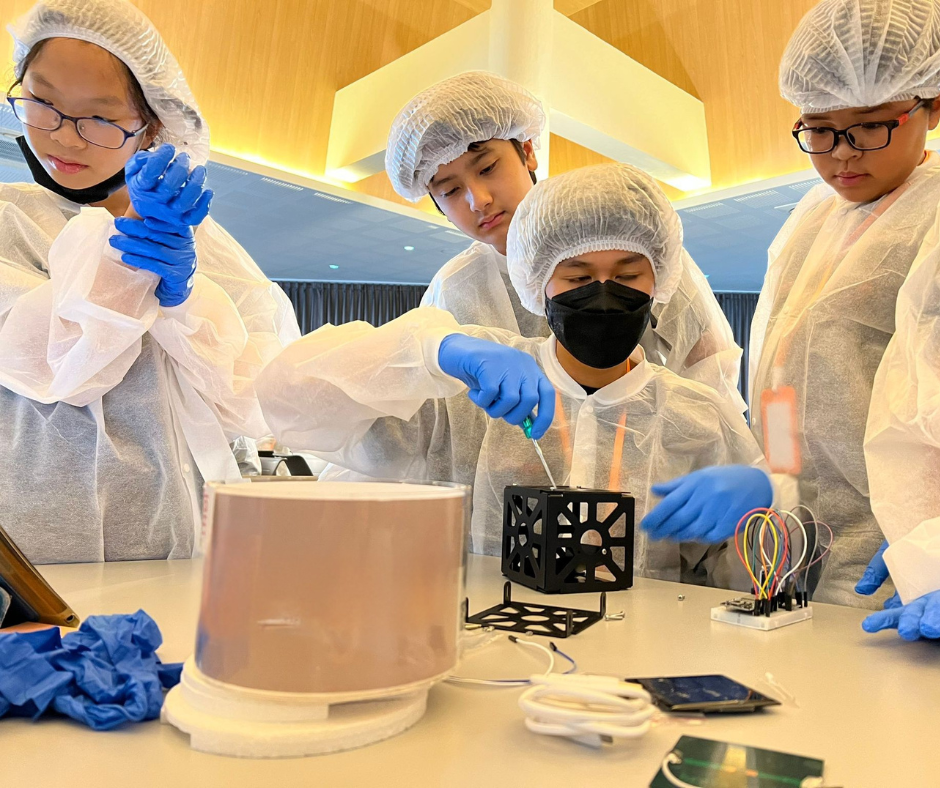
In cleanroom environments students assemble the CubeSat from off-the-shelf parts and custom electronics — soldering circuits, integrating payloads and running vibration tests, iterating on failures to build real engineering skill.

 03
Launch
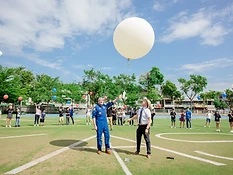
The launch phase often uses high-altitude balloons for deployment. Teams coordinate ascents to near-space altitudes, release the satellite, then monitor telemetry, communications and re-entry risks.
What Students Gain
Boost STEM Engagement: hands-on building increases retention by up to 40%.
Develop Soft Skills: leadership, presentation and teamwork integrated into every module.
Curriculum-Aligned: meets standards for physics, engineering and ethics; includes teacher resources.
Safe & Inclusive: every voice is heard, with scalable options for 10–200 students.
Real-World Impact: students design projects solving issues like climate monitoring.
Parent Appeal: builds resumes with NASA-inspired credentials.
What Our Students Say


Nattapon, 15
Ruamrudee International School, Bangkok
“The absolute best part of the whole CubeSat Challenge was getting to meet and work with a real astronaut. He told us stories about living on the Space Shuttle, showed us how astronauts train and helped us with our project.”


Freyue, 13
Sunway International School, KL
“I still can't believe I got to touch and help build my very own satellite. Wearing the full cleanroom suit, gloves and hairnet made me feel like a real NASA engineer.”


Lui, 14
KAS Taiwan
“Building a satellite sounds hard, but doing it with my team made it the most fun I’ve ever had learning. We all had different jobs: some coded the software, some soldered the boards, some designed the structure, and some wrote the mission plan.”
What Participants Get
Signed completion certificate
Every student receives a certificate personally signed by a NASA astronaut — a standout addition to any portfolio.
Signed program T-shirt
An exclusive signed T-shirt that commemorates their achievements on the program.
Photograph with a NASA astronaut
An unforgettable photo with a NASA astronaut. Program-dependent on which expert attends.
Bring The CubeSat Challenge to your school
Tell us about your students and your calendar. We'll design a tailored delivery and send a program brief within 24 hours.